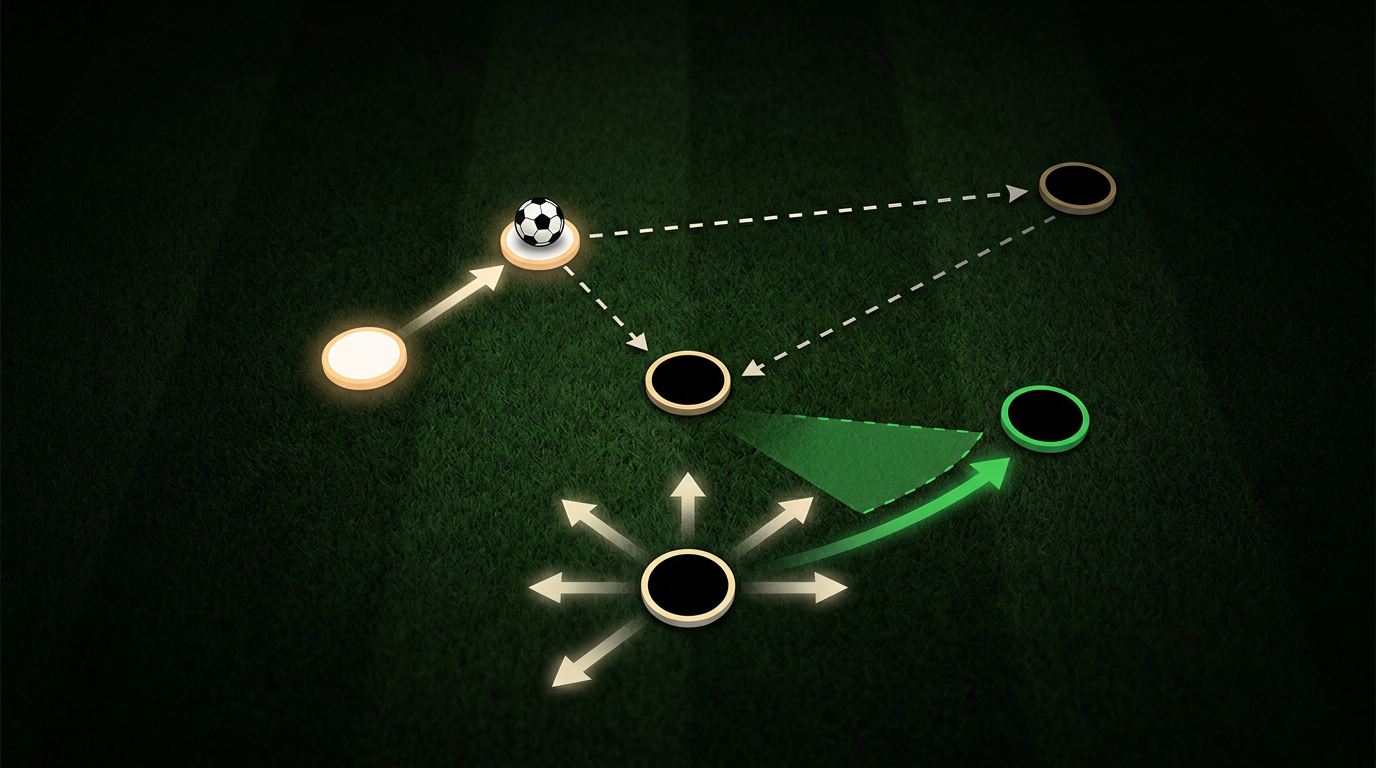
It’s a Sunday morning, and you’re on the touchline, watching the match unfold. An opposition player has the ball, deep in your child’s half. You see one of your child’s teammates charge forward, full of energy, to try and win it back. They’re pressing hard. But then you notice your own child, perhaps just a few feet away, doesn’t join in. They might hold their ground, or even drift away slightly. The attacking player often then has an easy pass out of trouble, or manages to wriggle free from the lone presser.
It can be frustrating to watch, can’t it? It might look like a lack of effort, or not paying attention. But for a young player, joining a press with a teammate isn't as straightforward as it seems from the sideline.
Understanding the immediate threat
When a teammate rushes to press an opponent, a young player's first instinct might be to focus on their own immediate responsibility. 'Where's my player?' or 'Is there someone behind me I need to mark?' These are valid questions in their head. They might not immediately register that the teammate's action has changed the landscape of the pitch for everyone else.
The ball-carrier, the teammate pressing, and a couple of other players might feel like a very small, isolated incident. What’s going on around the rest of the pitch can feel just as important, if not more so, than joining a teammate for a specific challenge. It’s about prioritising, and for a young player, that priority is often self-preservation or covering a perceived direct threat to their goal.
The fear of leaving space
One of the biggest concerns for a young defender is leaving a gap. If they see a teammate pushing up to press, their mind might immediately jump to the space that their own movement would create. 'If I go there, what happens here?' they might wonder, pointing to an area that another opponent could run into. It’s a very natural reaction for a young player who is still learning to trust their teammates and understand how interconnected defensive actions are.
Even though joining the press might be the 'better' footballing decision in that moment, the perceived risk of leaving a player free, or creating a channel for an opponent, can outweigh the benefit of helping a teammate. They're trying to protect the goal, and sometimes that means staying put.
The bigger picture is harder to see
Adults watching the game often have a wider view of the pitch and a better understanding of how a collective defensive action can quickly win the ball back. For a child, especially in the heat of the moment, their field of vision might be much narrower. They're focused on the ball, perhaps one or two opponents, and their own immediate role.
Seeing how their movement, combined with a teammate's, can 'trap' an opponent or cut off passing lanes requires a sophisticated understanding of space, time, and team coordination. It's not just about running to the ball; it's about running to the right space, at the right time, to support. That takes practice, communication, and a shared understanding that develops over many matches.