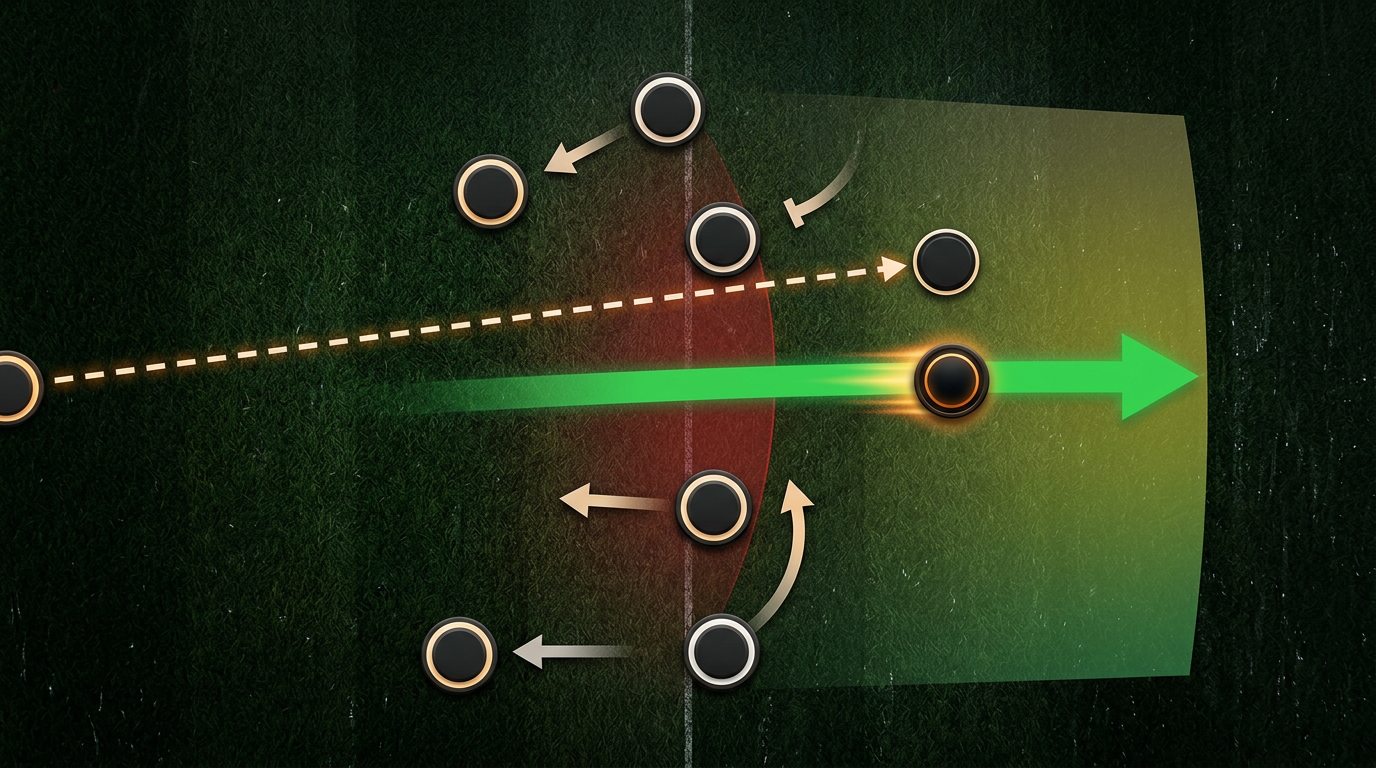
Picture this: the other team has the ball in midfield, and one of their players suddenly takes off like a rocket, sprinting past your child's defensive line. For a moment, it feels like time slows down. Will the pass come? Will your child see the run? More often than not, that attacker gets in behind, and you find yourself holding your breath as they bear down on your keeper. It's a tricky moment for any player, but for our young footballers, it’s a genuine puzzle to solve in real-time.
From the touchline, it can seem obvious. 'Just track your player!' we might think. But on the pitch, under pressure, with so many things happening at once, it’s far from simple. What does your child focus on in that split second? The ball? The player running? Both at once? That's the challenge.
The Pull of the Ball
It’s completely natural for young players to be drawn to the ball. It's the most exciting thing on the pitch, after all! Where the ball goes, everyone's eyes tend to follow. For a child learning the game, their attention is often almost entirely fixed on the player who has possession. It's where the action is, where the tackles happen, and where the next pass originates. This intense focus on the ball is a big reason why a sneaky attacker can often make a run completely unnoticed.
They’re not deliberately switching off or being lazy; they’re just so tuned into the immediate danger, the player with the ball, that the developing danger, the runner, slips from their perception. Imagine trying to read a book while someone is whispering something important just out of earshot. It's hard to divide your attention effectively.
The Challenge of Dual Awareness
Seeing both the ball and a runner at the same time is a skill that takes years to develop. It requires what coaches often call 'scanning' or 'checking your shoulders' – constantly glancing around to build a mental picture of what’s happening everywhere on the pitch. For a seven-year-old, this is asking a lot. Their peripheral vision isn't fully developed, and their ability to process multiple pieces of information simultaneously is still growing.
They might spot the ball, then quickly glance for a runner, only to look back at the ball just as the runner makes their move. By the time they look back again, the runner is already past them. It's like trying to juggle two balls when you’re only just learning to throw one straight. Their brains are working overtime just to keep track of the primary threat, let alone anticipating the next one.
Why "Goal-Side" Is a Foreign Concept
Once a defender has seen a runner, the next challenge is to get 'goal-side' – meaning, between the attacker and their own goal. This seems logical to an adult, but for a child, it's not always the immediate instinct. Their natural reaction might be to chase the runner, often running shoulder-to-shoulder or even behind them, rather than adjusting their position to cut off the pass or intercept the ball. They're trying to win the race, rather than thinking about the best defensive angle.
This isn't just about speed; it's about spatial awareness and understanding probabilities. They're still figuring out that being 'between' the ball and the goal is a stronger position than simply being 'near' the opponent. It’s a subtle but crucial difference that requires a developing tactical understanding of the game.