My Child Only Passes Forward: How to Teach Backwards and Sideways Passes

By Become Unplayable Team· 29 October 2026· 5 min read
My Child Only Passes Forward: How to Teach Backwards and Sideways Passes — Become Unplayable Playbook

Many young players only see forward passes. Learn why passing sideways or backwards is a vital skill and how to encourage it without adding pressure.

My child only passes forward, how do I teach them to pass backwards or sideways?

To teach a child to pass backwards or sideways, reframe the goal from 'advancing the ball' to 'keeping the ball'. Use small-sided games where keeping possession is rewarded. Instead of giving instructions, ask curious questions after the match, like "What could you do if the way forward is blocked?" This encourages them to see the whole pitch and value retaining possession as a successful outcome, rather than seeing a backwards pass as a failure.

It's a common sight in grassroots football: a young player gets the ball, head goes down, and they try to force a pass or dribble forwards, often straight into a crowd of opposition players. While the intent is positive, it highlights a one-dimensional view of the game.

Why Do Young Players Only Pass Forward?

Young players instinctively pass forwards because it's the most direct route to the goal. From their very first kick, the game is framed as 'get the ball in the other team's net'. This creates a strong directional bias. Sideline shouts of "Get it forward!" or "Shoot!" reinforce this instinct. For a U7 or U8 player in a 5v5 game, the logic is simple: the goal is that way, so the ball must go that way. They haven't yet developed the game understanding to see the value in a pass that moves away from the opposition's goal.

Why is Passing Sideways or Backwards Important?

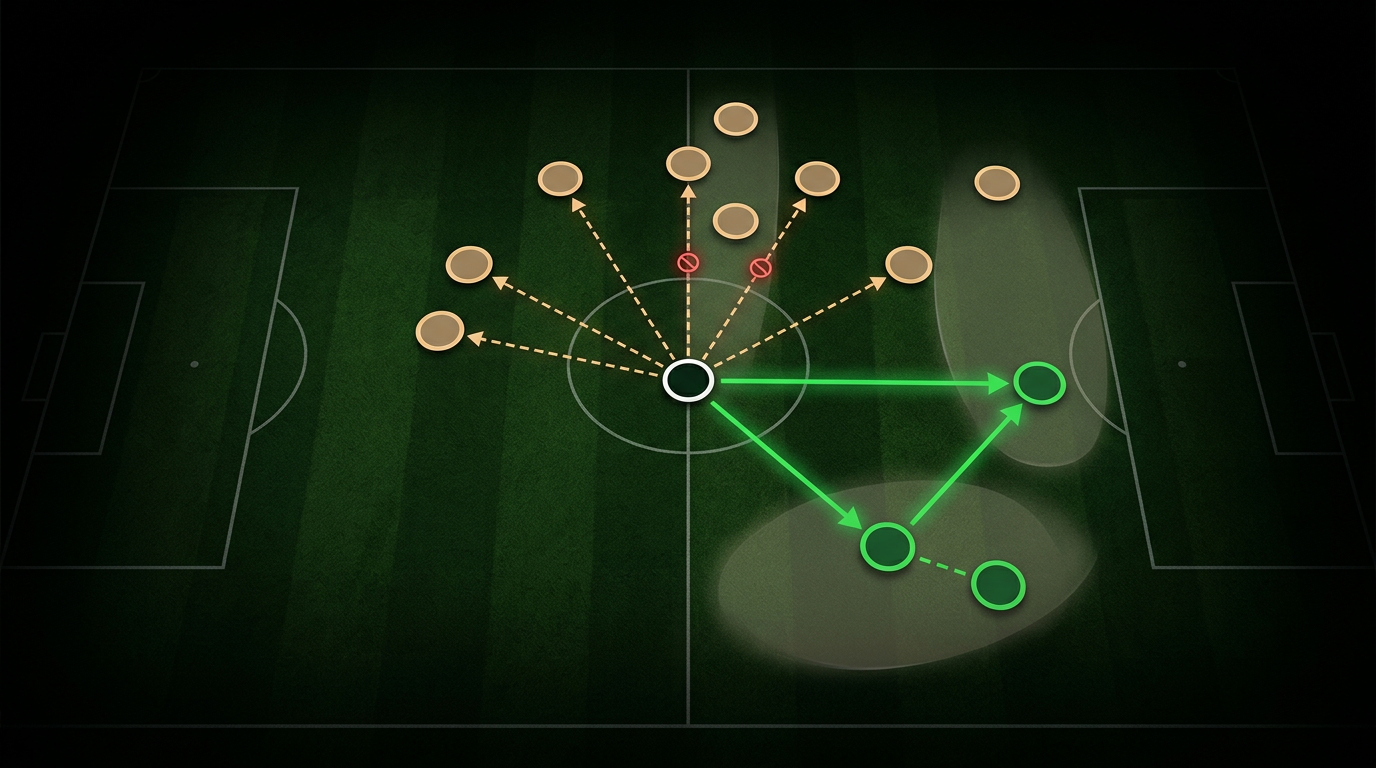
It's crucial for keeping possession of the football. A simple pass backwards can relieve pressure, reset an attack, and allow the team to switch the play to a less congested area of the pitch. Instead of losing the ball by forcing a risky forward pass, a sideways or backwards pass allows the team to stay in control. This patient approach can pull opposition players out of position, creating new spaces to attack moments later. It teaches players to solve problems with their brain, not just their boots.

What Parents Can Do

Your role is to encourage thinking, not to coach from the sideline. During a match, resist the urge to shout instructions. Afterwards, in a relaxed setting, you can use questions to help them reflect.

  • Praise the decision, not the direction: If they make a smart pass to keep the ball, praise it. "I thought it was really clever when you were surrounded by their players and you passed back to your defender so we could keep the ball."
  • Ask curious questions: "It looked really crowded in front of you on that play. Did you see any other space?" This is not to criticise, but to prompt them to recall the picture in their head.
  • Watch football together: Point out when professional players pass backwards or sideways to escape pressure. Say, "See? Even the best players in the world pass back to keep the ball."

What Coaches Can Do

For coaches of U7-U10 players, the aim is to create game-like scenarios where passing backwards and sideways becomes a natural solution.

  • Use Possession Games: Small-sided games like 3v1 or 4v2 'rondos' (keep-away) are perfect. The objective is simply to keep the ball, so players quickly learn to use the teammate in the easiest position, regardless of direction.
  • Add Conditions to Games: In a small match, award points for a certain number of consecutive passes (e.g., 5 passes = 1 goal). This shifts the focus from just scoring to valuing possession.
  • Coach the 'Why': When a player makes a good decision to pass backwards, pause the session and briefly praise it. "Great idea, Jack. You saw the way forward was blocked, so you kept the ball for us. Now, can we switch the play?" This reinforces the learning for the whole group.

When is it Okay to Pass Backwards?

It is always okay to pass backwards if it's the best decision for the team to keep the ball. There are no rules against it, and it's a fundamental part of how football is played at every level. A player should consider a backwards or sideways pass when:

  • They are under immediate pressure from an opponent.
  • The path forward is blocked by multiple defenders.
  • They want to draw an opponent towards them to create space for others.
  • The team wants to switch the attack to the other side of the pitch.
Related reading

Common questions

My child only passes forward, how do I teach them to pass backwards or sideways?

To teach a child to pass backwards or sideways, reframe the goal from 'advancing the ball' to 'keeping the ball'. Use small-sided games where keeping possession is rewarded. Instead of giving instructions, ask curious questions after the match, like "What could you do if the way forward is blocked?" This encourages them to see the whole pitch and value retaining possession as a successful outcome, rather than seeing a backwards pass as a failure.

At what age should children learn to pass backwards in football?

Players can start learning as soon as they play in a team (U7/U8). It should not be a complex tactical instruction but encouraged through fun, small-sided games. The concept is simple: if you can't go forward, find a teammate in space, wherever they are. At this age, the goal is for them to discover it as a solution, not to be explicitly coached on it.

Won't my child get shouted at for passing backwards?

While some unhelpful sideline comments are common in youth football, most modern coaches understand the importance of keeping possession. A smart backwards pass is a positive action. The focus should always be on making a good decision, not the direction of the pass. If your child is praised for good decisions, they will build the confidence to ignore negative comments.

How do I praise a backwards pass without confusing my child?

Focus on the intelligence behind the decision. Instead of a simple "good pass," try saying, "That was a really smart pass back because their players were closing you down. You made sure our team kept the ball." This links the action (pass) to the positive outcome (keeping possession) and reinforces the 'why'.

Is 'pass forward, move forward' not good advice?

It's an oversimplification that can be unhelpful. While attacking is the aim, forcing the ball forward into crowded areas just leads to losing it. Better advice is to 'play what you see' or 'find the open player'. This encourages players to scan, assess the situation, and choose the best pass available—forward, sideways, or backward—to help the team.

About the author

Become Unplayable

Become Unplayable creates tools and resources designed to help young footballers think about the game, understand situations and develop better decision-making habits.

The card game that teaches kids how to think like a footballer.

Help young players improve their decision-making, positioning, teamwork and football intelligence through fun match-day scenarios. Designed for ages 7–13. No coaching experience required.

Become Unplayable Foundation Pack cards and box

Join the waiting list

By joining you agree to receive Become Unplayable updates by email. Unsubscribe anytime.

Continue reading

More from The Playbook to help you understand your young footballer.

Back to The Playbook

Explore all our articles for parents of young footballers.