When a coach shouts out numbers like '4-4-2' or '3-5-2', it can sound like a secret code. For young players, and even their parents, the concept of a football formation can be confusing. The key is to simplify it, moving away from abstract numbers and towards practical ideas about space, roles, and teamwork.
Are Formations Important for Young Players?
Yes and no. For younger age groups like U9s and U10s playing 7-a-side, rigid adherence to a formation is less important than understanding core principles. At this stage, concepts like creating space, providing a passing option for a teammate, and basic defensive positioning are the priority. Coaches use formations like a 2-3-1 as a simple starting structure to ensure the team has balance, with players covering defensive, middle and attacking areas of the pitch. As players move to 9-a-side (U11/U12), the formation provides a slightly more detailed framework for how units (defence, midfield, attack) work together on a larger pitch.
How Can I Explain Formations Simply?
The most effective way to explain formations is to avoid jargon and use simple, relatable concepts. Instead of memorising numbers, focus on shapes, jobs, and zones.
- **Talk About 'Jobs'**: Every position has a primary job. Defenders' main job is to stop the other team from scoring. Midfielders connect the defenders to the attackers. Attackers have the job of creating chances and scoring goals. This helps a child understand their purpose on the pitch.
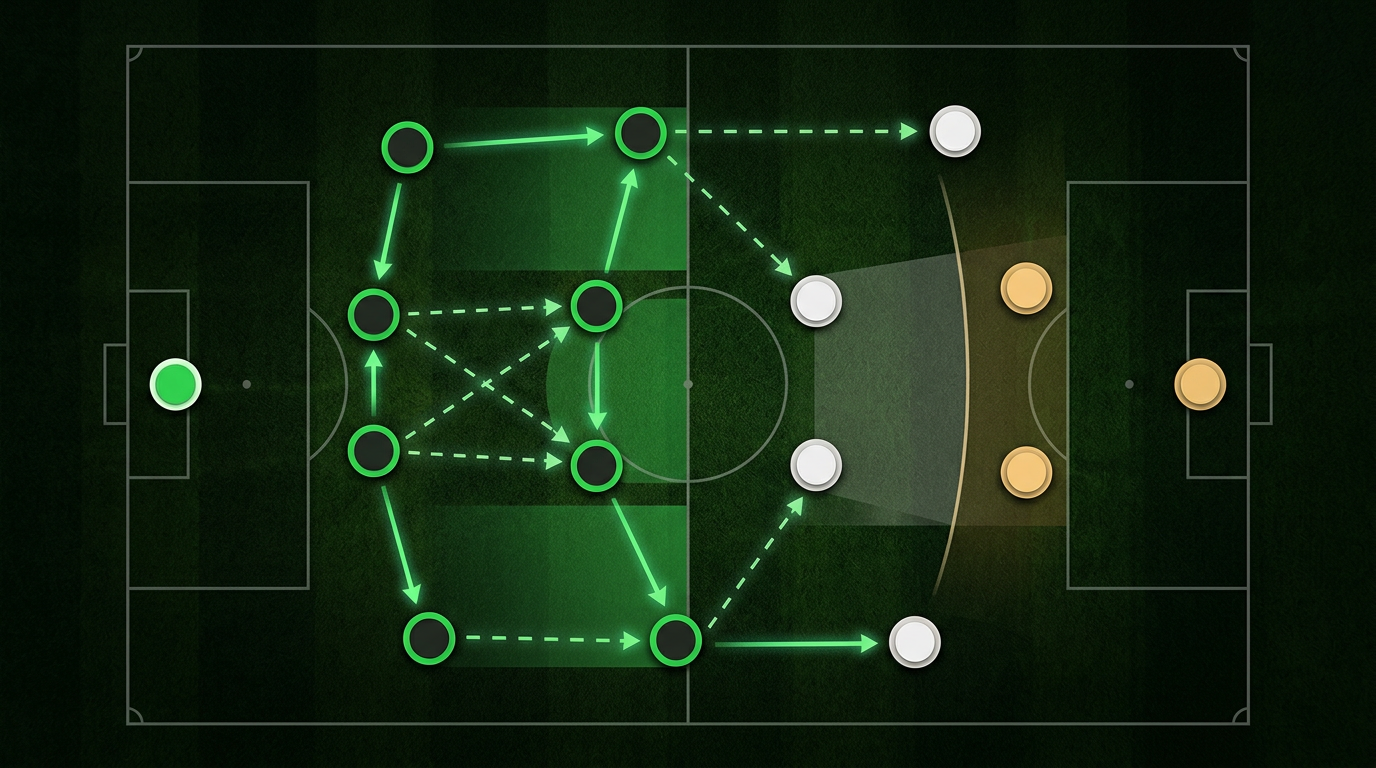
- **Use 'Shapes'**: Point out the triangles and diamonds players make on the pitch. For example, in a 4-3-3, a full-back, central midfielder, and winger naturally form a triangle. This shape makes it easier to keep the ball. Talking about 'making a triangle' for a teammate is more practical than telling them to remember a formation.
- **Divide the Pitch into 'Zones'**: You can talk about the defending third, middle third, and attacking third. A formation is just a way of making sure your team has players in all three zones, both when attacking and defending. Ask your child which zone their position is mainly in.
- **Use Visuals**: Away from the pitch, use a whiteboard, magnetic tactics board, or even condiments on a dinner table to represent players. Walk through simple scenarios: 'If the ball is here, where would you stand to help your teammate?'
How Does a Formation Affect My Child's Role?
A formation gives a player a 'home base' and defines their main responsibilities in and out of possession. For example, a wide player in a 4-4-2 (in 11-a-side) often has more defensive responsibility than a winger in a 4-3-3, who is encouraged to stay higher up the pitch. Similarly, playing in a two-person midfield requires a different understanding of space and defensive duties compared to playing in a three. The key is for a player to understand their role in relation to the players closest to them. Do they have a full-back overlapping them? Do they have one or two strikers to aim for? These relationships are what bring a formation to life.
What Parents Can Do
- **Watch games together:** When watching a match on TV, occasionally point out the team's shape. 'See how their four defenders try to stay in a line?'
- **Ask curious questions:** After a match, ask 'What did your coach ask you to do today?' or 'When your winger had the ball, where was the best place for you to be?' This encourages reflection without being critical.
- **Keep it fun:** Never make discussions about formations feel like a test or lecture. The aim is to build understanding in a low-pressure way.
- **Praise awareness:** Acknowledge moments when they showed good spacing or supported a teammate, not just when they scored a goal or made a tackle.
What Coaches Can Do
- **Coach principles, not just positions:** For U9-U12s, focus on teaching concepts of width (stretching the play wide), depth (having players high and deep) and support (getting close to the player on the ball).
- **Use constraints-led games:** Set up small-sided games with zones that players are encouraged to stay in to learn about their areas of responsibility naturally.
- **Use functional language:** Instead of just 'centre-back', you could say 'our deep player' or 'our player who links the play' to reinforce their job.
- **Encourage rotation:** Let players experience different positions in training to build empathy and a broader understanding of how the team fits together.