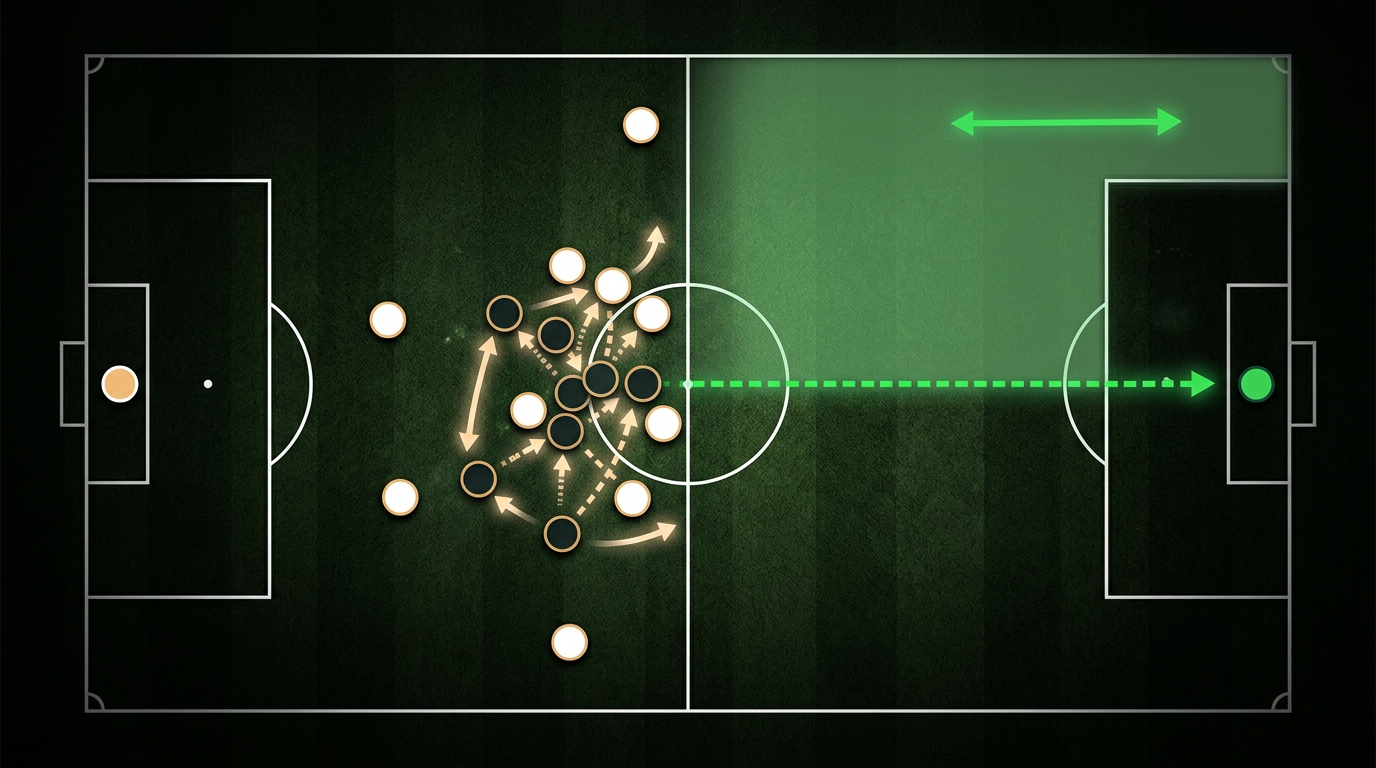
Picture this: your child has the ball, or is about to receive it, but the whole opposition team seems to be swarming their side of the pitch. It's a crowded mess, a tangle of legs and shirts. But then, you glance across to the opposite wing, and there’s a teammate, completely unmarked, waving for the ball, practically doing star jumps in acres of space. From your vantage point, it feels so obvious, doesn't it?
The ball arrives, the immediate pressure builds, and your child either tries to dribble through the crowd, or perhaps just kicks it forward into the busy area. Meanwhile, that wide-open space on the far side remains untouched, a missed opportunity that leaves you wondering, 'Why didn't they just pass it over there?'
The Tunnel Vision Effect
When a young player is on the ball, especially under pressure, their world can shrink dramatically. Imagine trying to solve a puzzle while someone is constantly trying to take the pieces away from you. The focus becomes hyper-localised: the ball, the nearest opponent, and maybe the teammate directly in front. It's a natural survival instinct – dealing with the immediate threat.
Looking up and across the entire pitch to spot a distant, free teammate requires a specific type of awareness and composure that develops over time. It's not just about seeing; it's about processing the information quickly enough to act on it before the moment is gone. Their developing brains are still working out how to manage all these inputs simultaneously.
Why Wide Spaces Can Feel Distant
For a child, a pass across the width of the pitch feels like a much bigger challenge than a shorter pass. It’s a longer distance, a harder kick, and carries a higher risk of going astray or being intercepted. Many young players prioritise keeping possession with a safer, shorter pass, even if it's into a more congested area. They might not yet have the confidence in their technique to execute a longer, more precise pass under match conditions.
Also, their 'mental map' of the pitch might be less developed. They know where the goal is, and generally where their teammates are, but the idea of 'using the whole pitch' to create space might not yet be an active consideration during play. They’re often thinking forward, towards the goal, rather than outward to the wings.
It's More Than Just 'Looking Up'
We often hear coaches tell players to 'look up!' But for young players, looking up needs to be tied to understanding what to look *for*. Seeing a teammate across the pitch is one thing; understanding that passing to them will relieve pressure and create a better attacking opportunity is another. This understanding takes time, experience, and the chance to make mistakes and learn from them.
They are learning to make complex decisions in a split second, often with pressure coming from all sides. It’s a bit like learning to drive: at first, you’re concentrating so hard on the gear stick and the mirrors, you might not notice the scenic view or the subtle changes in the road ahead. With practice, these things become second nature.