For U9 and U10 players in 7v7 football, the focus of training shifts from individual ball mastery towards developing game understanding. The most effective practices are those that look and feel like football itself.
What Should U10s Be Learning in Football Training?
At the U9 and U10 level, players should be learning how to apply their technical skills within the context of the game. While dribbling and passing remain important, the emphasis moves towards 'why' and 'when' to use these skills. This is the age to introduce the foundational habits of football intelligence.
- **Scanning:** Looking before receiving the ball to build a picture of the pitch.
- **First Touch:** Taking a first touch that moves the ball into space and away from pressure.
- **Simple Support:** Understanding how to move to help the player on the ball.
- **Basic Decisions:** Choosing between passing, dribbling, turning or shooting based on the situation.
- **Introduction to Shape:** Learning to maintain general positions (defence, midfield, attack) rather than bunching around the ball.
How Do You Teach Scanning to 9 and 10-Year-Olds?
You teach scanning by creating games where it is essential for success, rather than simply shouting "scan!" from the sideline. The player's brain needs to recognise the benefit of looking. The goal is to make scanning an unconscious habit that happens in the split-second before the ball arrives.
A simple but highly effective practice is the 'Gates Game'. Set up a 20x20 yard area with four or five small 'gates' (two cones a yard apart) scattered inside. Play 3v3 or 4v4. A team scores a point by passing to a teammate through one of the gates. To succeed, players must constantly scan to see which gates are open, where their teammates are, and where the defenders are closing from. Praise the 'look' as much as the successful pass.
Effective Small-Sided Games for 7v7 (U9/U10)
The best practices for this age group are directional, competitive, and involve opposition. They should be easy to set up and adapt. Here are two examples that work well.
1. 3v2 Overload to Goal
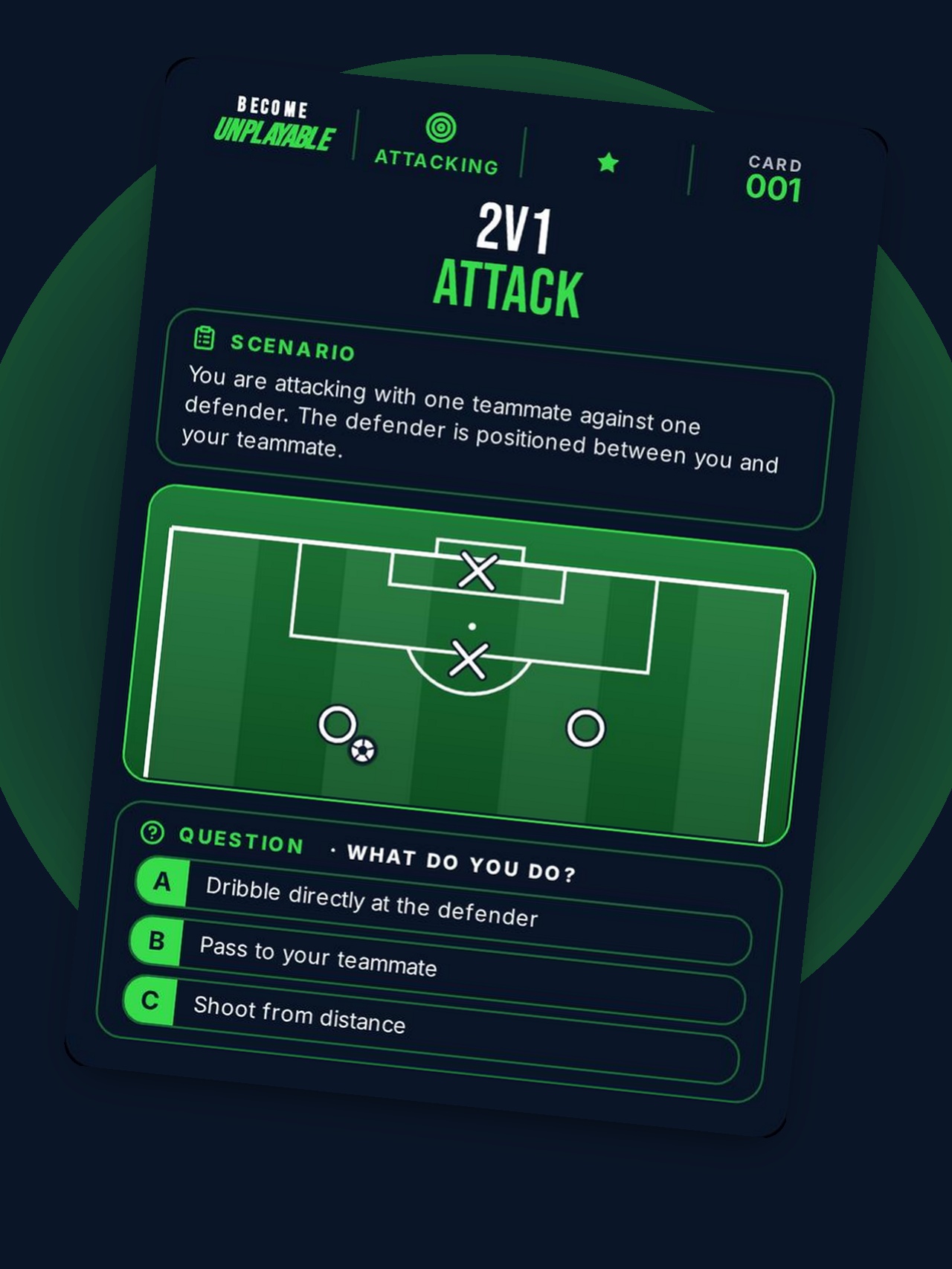
**Setup:** Use one end of a 7v7 pitch with a keeper in the goal. Three attackers start at the halfway line against two defenders. The coach plays a ball to the attackers, who try to score. **Focus:** This forces the attackers into quick decisions: when to pass, when to dribble, and when to shoot. It teaches the defenders to communicate and decide who presses the ball and who covers the space or other players. Rotate players through all positions.
2. End Zone Possession Game
**Setup:** Create a 30x20 yard pitch with a 5-yard 'end zone' at each end. Play 4v4 or 5v5. A team scores a point by successfully receiving a pass inside the opposition's end zone. **Focus:** This encourages players to look for forward passes but also teaches them the value of keeping the ball. If they can't play forward, they must learn to pass sideways or backwards to a teammate in a better position to open up a new angle. It's a great introduction to playing out from the back.
What Coaches and Parents Can Do
Support for a U10 player is about encouragement and asking questions, not providing answers.
- **Coaches:** During breaks, use guided questions like, "What did you see on the pitch that helped you decide?" or "Where was the most space?" Praise good decisions and attempts to scan, even if the outcome isn't perfect.
- **Parents:** After a match, avoid giving instructions. Instead, ask open questions like, "What was the most fun part of the game?" or "Did you feel like you had much time on the ball today?" This helps them reflect without feeling judged.