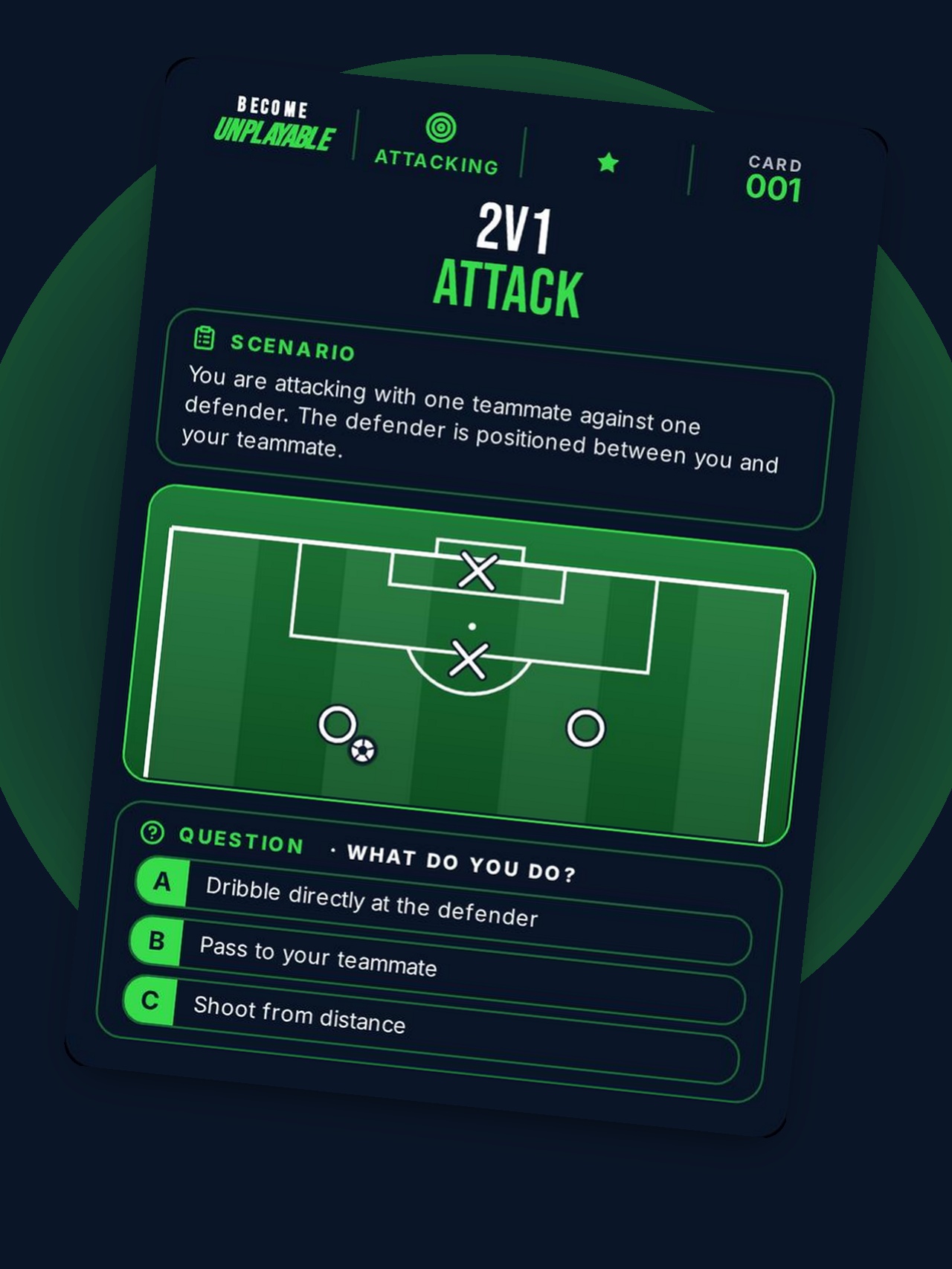
Playing football on a huge 11-a-side pitch can be a lonely experience for a seven-year-old. The ball might seem miles away, and opportunities to get involved are few and far between. This is the problem small-sided games are designed to solve.
Why Does The FA Use Small-Sided Formats?
The FA mandates small-sided formats because they create a better learning environment for young players. The approach is child-centric, scaling the game to fit the players, rather than forcing children to cope with the adult version. By reducing the number of players and the size of the playing area, the game becomes simpler to understand and easier to participate in.
This structure ensures that children are constantly involved in the match. Instead of being a distant spectator on the wing of a full-size pitch, every player in a 5v5 game is only ever a few seconds away from the action. This increases engagement, builds confidence, and accelerates the development of core football skills and decision-making.
What Are the Official Youth Football Formats?
In England, The FA's player pathway outlines a gradual progression from smaller to larger formats as children grow.
- **Under 7s & Under 8s (5v5):** This is the first step into team football, typically played with four outfield players and a keeper. The pitch is small (around 40x30 yards), and there is no offside rule. The focus is on fun, basic ball control, and learning to be part of a team.
- **Under 9s & Under 10s (7v7):** The teams and pitch size increase (around 60x40 yards), providing more space and introducing more complex team dynamics. This format helps players begin to understand team shape and positioning in a manageable way.
- **Under 11s & Under 12s (9v9):** This is the final transitional stage before 11-a-side. The pitch is larger again (around 80x50 yards), and the offside rule is introduced. 9v9 helps players adapt to the challenges of a bigger pitch and more tactical concepts while still ensuring high levels of involvement.
This staggered approach allows players to build their understanding of space, positioning, and teamwork incrementally.
How Do Small-Sided Games Increase Player Involvement?
Fewer players on the pitch mathematically guarantees that each individual will touch the ball more often. While exact numbers vary, coaching research consistently shows that players in small-sided games have significantly more contact with the ball compared to 11v11 matches. They perform more passes, take more shots, and engage in more 1v1 duels.
Crucially, more touches lead to more decisions. Every time a player receives the ball, they must perceive the situation, decide what to do (pass, dribble, or shoot), and then execute the action. A small-sided game condenses a match's worth of these learning cycles into a shorter period, rapidly accelerating a player's game intelligence.
What Coaches Can Do
- **Use small-sided games in training:** Don't just save them for match day. Use 2v2s, 3v3s, and 4v4s to create high-intensity drills that focus on specific skills or tactical ideas.
- **Coach principles, not just positions:** In 5v5 and 7v7, encourage players to understand their roles in attack and defence rather than being fixed to one spot on the pitch.
- **Encourage decision-making:** Let players make mistakes. When a pass is misplaced, ask them what they saw and if there was another option, rather than simply criticising the execution.
- **Rotate players:** Ensure all players experience different roles and have fair playing time. The aim is development for all, not just winning the match.
What Parents Can Do
- **Understand the 'why':** Appreciate that a 'chaotic' 5v5 game is a rich learning environment. Resist the urge to compare it to the 11-a-side game you see on television.
- **Praise the right things:** Focus on effort, bravery on the ball, good decisions, and teamwork, not just goals or the final score.
- **Avoid sideline instructions:** Shouting "Boot it!" or "Get rid of it!" undermines the coach and contradicts the very purpose of small-sided games, which is to encourage players to be comfortable on the ball.
- **Ask supportive questions:** After the match, ask things like, "What was the most fun part?" or "Tell me about a time you had to make a quick decision." This helps them reflect on their experience positively.