Good defensive positioning is less about being told exactly where to stand and more about understanding a few simple principles. For young players in 7v7 or 9v9 football, mastering these ideas is the first step towards becoming a composed and effective defender.
How Can Young Defenders Learn Where to Stand?
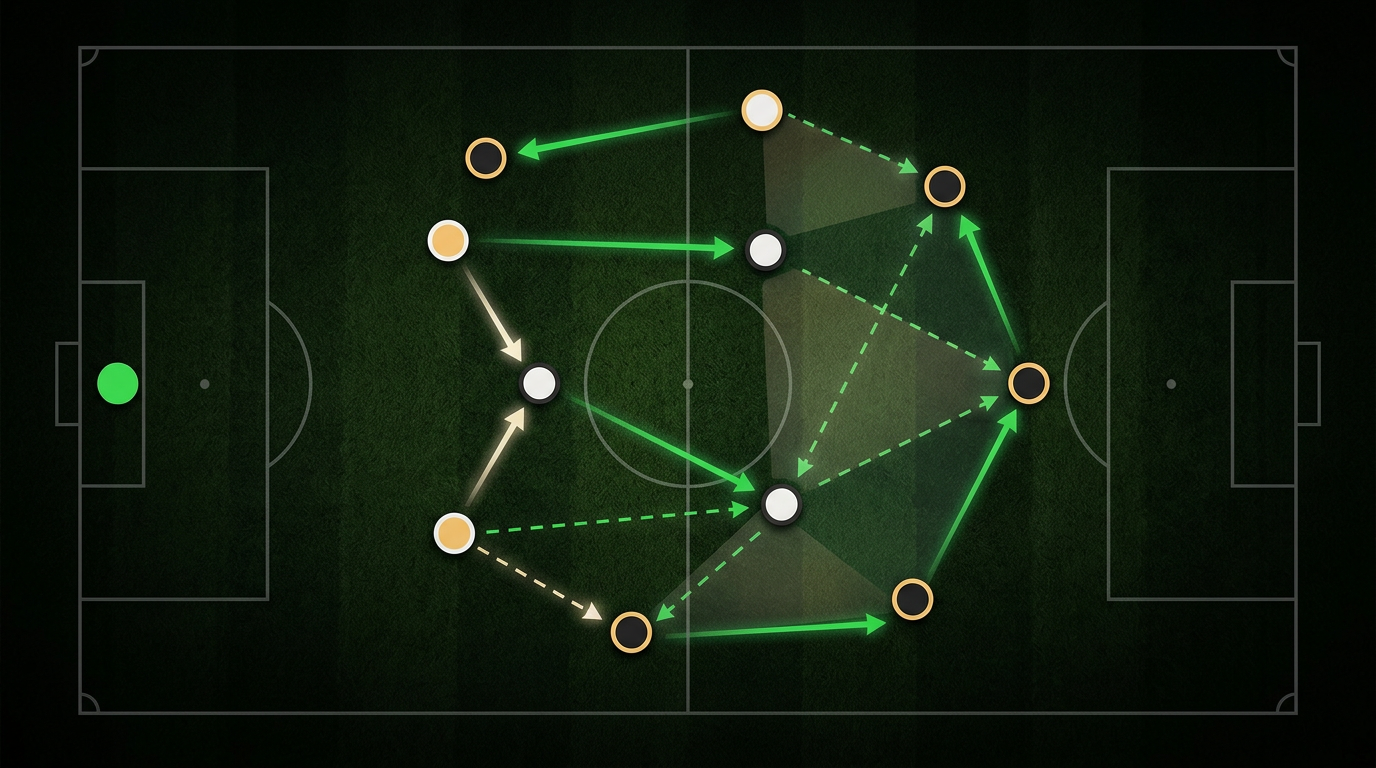
Young defenders can learn where to stand by using three reference points: the ball, their opponent, and their own goal. The ideal position changes as these three things move. The core aim is to keep your body between the opponent and the goal, while still being able to see the ball. This is often called being 'goal-side'.
Instead of focusing on specific spots on the pitch, encourage players to think about this relationship. A simple way to visualise it is as a triangle. The defender should try to be at one corner of a triangle, with the ball and the attacker at the other two corners, while always ensuring the goal is behind them.
What Are the Simple Rules for Covering Space and Players?
For players in the U9 to U12 age groups, complex tactical systems are unnecessary. Instead, focusing on three simple, repeatable rules builds a strong foundation.
- **Stay Goal-Side:** Always try to keep your body between the attacker and the centre of your goal. If the attacker gets past you on the 'goal side', they have a clear run to score.
- **See Ball and Player:** Adopt a 'side-on' body stance. This opens up your view, allowing you to see the person with the ball and the opponent you are marking. If you face the ball directly, you can't see the player behind you. If you only face the player, you won't know when the pass is coming.
- **Be Close Enough to Help:** Be near enough to your opponent to challenge them if they receive the ball, but with enough space (often 1-2 arm's lengths) so you don't get beaten by a quick turn or a sprint into space behind you. This distance changes depending on how close to your goal you are.
Man-Marking vs Zonal Defending: What's Best for Young Players?
For U9-U12s, the distinction is less important than understanding the principles above. Coaches often use a mix of both concepts without needing to use the jargon. At this age, players often gravitate towards man-marking (following a specific player) because it feels simpler.
- **Simple Man-Marking:** 'You mark number 7'. This is easy to understand but can lead to players being dragged out of position and leaving big gaps.
- **Simple Zonal Defending:** 'Protect the area in front of the goal'. This is better for team shape but can be confusing if no attacker is in your 'zone'. Players often don't know who to mark.
A good approach for coaches is to give players responsibility for the opponent who enters their area of the pitch. This combines the ideas. The key coaching point remains the same: no matter who you are marking, stay goal-side and try to see both the player and the ball.
What Parents Can Do
Your role is to encourage thinking, not to give instructions from the sideline. Shouting 'get tighter!' or 'mark him!' often adds pressure without improving understanding.
- **Ask Questions Later:** After the match, ask things like, "When that fast striker got the ball, what were you trying to make them do?" or "What's the hardest thing about defending when the ball is on the other side of the pitch?"
- **Watch the Pros Together:** When watching a match on TV, pick one defender and just watch them for five minutes. Ignore the ball. Where do they stand? How does their position change relative to the ball and their nearest opponent?
- **Praise the Decision:** Acknowledge good positioning, even if it doesn't result in a big tackle. A comment like, "I noticed you kept that player from turning towards goal, that was really clever positioning," values the thought process, not just the outcome.
What Coaches Can Do
Use small-sided games and constraints to create situations where players discover these principles for themselves.
- **1v1 and 2v2 Games:** These are the best environments to learn positioning. The defender is constantly forced to adjust based on the ball and the attacker.
- **Use Gates or End Zones:** Instead of a big goal, have attackers try to dribble through one of two small cone 'gates'. This forces the defender to position themselves to protect both gates, teaching them to guide attackers and protect the most dangerous space.
- **Simple Language:** Use phrases like 'Ball-Side, Goal-Side', 'Can you see the ball and your player?', and 'Show them the line' (encourage them down the wing) rather than complex tactical terms.